Schedule Risk Analysis: How Confident Is Your Completion Date?
Schedule risk analysis asks a question a normal programme cannot answer: given everything that could go differently, how likely is the completion date you are...


Project controls is the discipline of measuring whether a project is going to hit its time and cost targets, and providing early enough warning to do something about it. It sits between the planning function and the commercial function, and on larger contractors it is a department in its own right.
It normally covers planning and scheduling, cost control and forecasting, change management, risk management, progress measurement, and reporting to leadership and the owner. The unifying idea is comparison: what did we say would happen, what is happening, and what does the gap mean for the outturn.
Project controls software is anything that supports that comparison. In practice the term covers a wide range of tools, from enterprise suites down to a scheduler with Primavera and a very well maintained spreadsheet, which is why evaluations in this category are unusually hard to run.
Project controls is often confused with project management, and the distinction matters when deciding what to buy.
Project management is responsible for delivering the work: making decisions, directing the team, resolving issues. Project controls is responsible for measuring and forecasting: providing the analysis those decisions rest on. One acts, the other informs, and a controls function that starts making delivery decisions has usually stopped doing controls.
This distinction explains most disappointment in the category. A construction management platform such as Procore is built around executing and recording work: RFIs, submittals, daily logs, documents. A project controls tool is built around analysing it: variance against baseline, forecast at completion, schedule quality, risk exposure. Both are legitimate. Buying one expecting the other is where budgets get wasted.
A useful test: does this tool tell me what happened, or what it means for the outturn? Systems of record answer the first question well. Controls tools are supposed to answer the second, and many do not.
Baseline and variance. Hold an agreed baseline, measure progress against it, and show variance by activity, package and milestone. Without a preserved baseline there is nothing to control against.
Progress measurement with an evidence trail. Percentage complete must rest on something: quantities installed, milestones passed, inspections signed. A forecast built on unevidenced percentages is arithmetic performed on opinion.
Forecasting rather than reporting. Estimate at completion and forecast completion date, updated as conditions change. A tool that only reports the past is a reporting tool.
Change and its cumulative effect. Track pending and approved change orders against both cost and programme, including float consumed where no extension was claimed.
Schedule quality and risk. Check logic health, constraint abuse and float distribution, and support schedule risk analysis. A programme can be perfectly maintained and structurally unsound.
Portfolio visibility. Comparable data across projects, so leadership can see which jobs are exposed and where the same failure keeps recurring.
Project controls has a structural weakness that no amount of analytical sophistication fixes. Everything it produces depends on data arriving from the field, and that data arrives monthly, second hand, and filtered through whoever compiled it.
The consequence is a familiar pattern. A project reports green through three monthly cycles and then moves to red without an intervening amber. Nothing changed suddenly. The information simply took eleven weeks to reach the report, by which time the options that existed in week two were gone.
The signals were present much earlier: approvals ageing past the date the work needed them, subcontractors who never confirmed, deliveries quietly moving, predecessors drifting. None of those appear in a monthly progress return, because they are operational facts rather than reported percentages, and they live in systems that never talk to the schedule.
So a controls function that only tightens its reporting cycle is solving the wrong half of the problem. Better analysis of late data still produces late warnings.
The way to shorten that lag is to capture information where it is generated rather than collecting it afterwards. Progress reported by the crew doing the work, readiness confirmed by the subcontractor who will perform it, approvals tracked against the date the work needs them rather than the date they were raised.
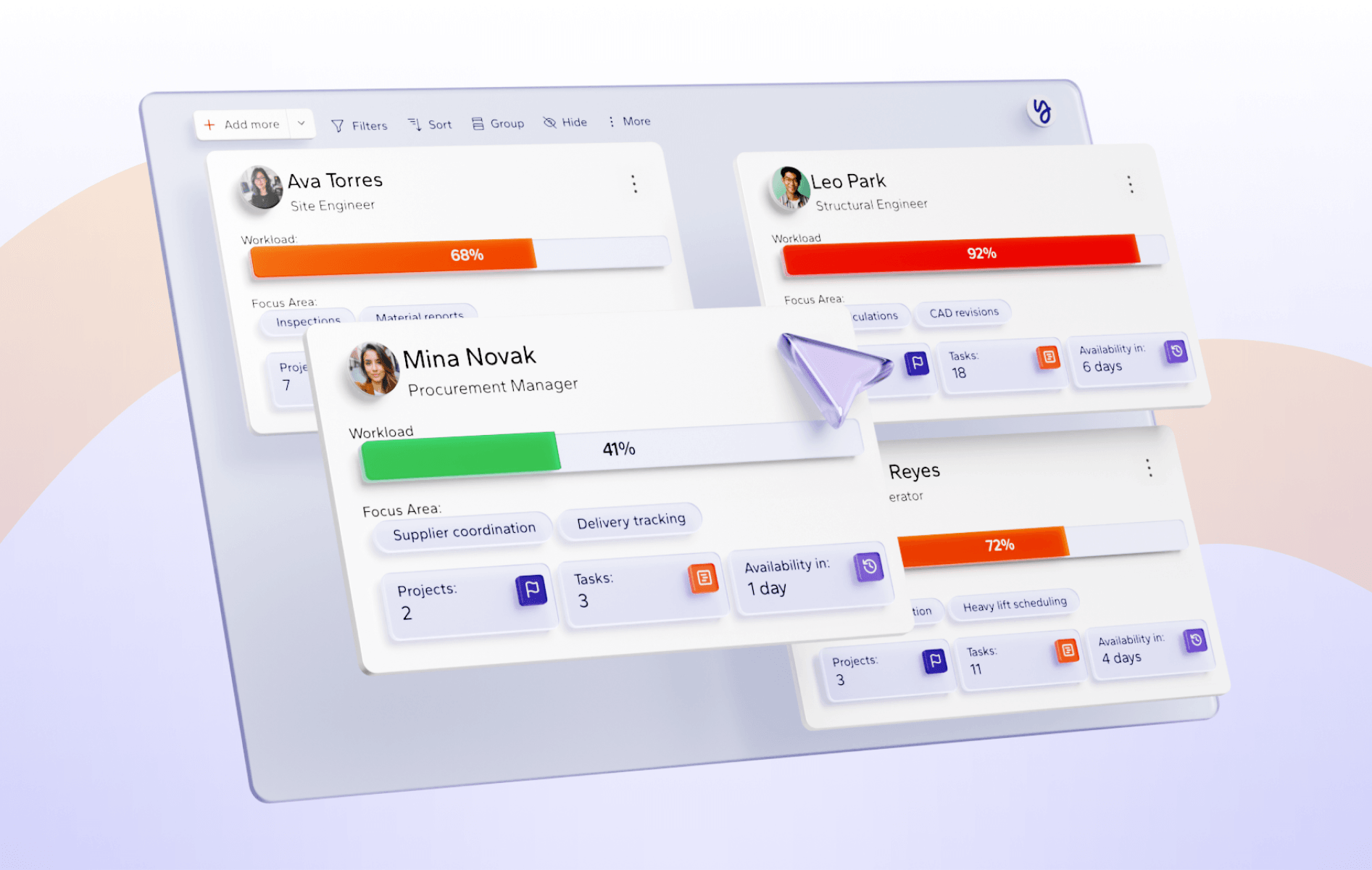
This is where Playbook fits alongside a controls function rather than replacing it. Readiness, commitments, blockers, approvals and field updates are tracked against the activities they affect, so exposure is visible continuously instead of at the next reporting cycle, and each flag carries the evidence behind it. Leadership can see which projects are exposed and why, while the schedulers and cost engineers keep doing the analysis that requires professional judgement.
It is worth being explicit about the boundary. This does not replace a master scheduling engine for contractual programmes, nor a cost system for financial control, nor an experienced project controls professional. What it changes is how quickly the operational reality reaches the people producing the forecast.
What is project controls software?
Project controls software supports measuring and forecasting project time and cost performance. It typically covers baseline and variance analysis, progress measurement, cost forecasting, change tracking, risk analysis and portfolio reporting.
What is the difference between project controls and project management?
Project management is responsible for delivering the work and making decisions. Project controls is responsible for measuring performance and forecasting outcomes so those decisions are informed. Controls informs, management acts.
Does a construction management platform cover project controls?
Partly. Platforms such as Procore and Autodesk Construction Cloud are strong systems of record for documents, RFIs and daily logs, but they are built around executing and recording work rather than analysing variance and forecasting outturn. Many organisations run both.
Why does project controls reporting lag what is happening on site?
Because it depends on data collected periodically and second hand. Operational signals such as ageing approvals, unconfirmed subcontractors and slipping deliveries exist weeks before they appear in a monthly report, which is why projects often move from green to red with no amber in between.
Note to editors:
High-resolution images and interviews with PYBK leadership team members are available upon request.

There is no single best construction scheduling tool, and any list that names one is answering a different question from the one you are asking. What exists...

OAC stands for Owner, Architect, Contractor. An OAC meeting brings those three parties together on a regular cycle, usually weekly or fortnightly, to review...

A schedule of values is a breakdown of the contract sum into the individual work items that make it up, used as the basis for progress payments. Each line...