Construction Project Controls Software: What It Does and Where It Falls Short
Project controls is the discipline of measuring whether a project is going to hit its time and cost targets, and providing early enough warning to do something...


Ask a project team why the job slipped and you will usually hear a list of events: the permit was late, the steel did not arrive, the design changed, it rained for two weeks. Each is true. None of them explains why the team did not know earlier.
That difference matters, because the two questions lead to different responses. Treating the event as the cause produces better excuses. Treating the detection failure as the cause produces a better process.
Weather is the honest exception. Nobody detects a storm eight weeks out. Almost everything else in the list below leaves a trail well before the crew is due on site, and the trail is normally visible to somebody on the project. It just is not visible to the schedule.
Late information and approvals. Unanswered RFIs, unapproved submittals, drawings still in review and decisions sitting with the owner or consultant. These are the most predictable delays on any project, because the clock is visible from the day the request is raised. The signal is the ageing of the item against the date the work needs it.
Procurement and material availability. Long lead items ordered late, deliveries slipping, or a substitution requiring re approval. The signal is usually a confirmed delivery date that quietly becomes an estimated one.
Labour availability and subcontractor performance. A crew pulled to another job, a trade that consistently arrives at seventy percent of promised manpower, or an activity nobody ever confirmed. The signal is the absence of a confirmation, which is why silence should never be recorded as agreement.
Predecessor work not finished to the agreed standard. Reported complete but not actually handed over: the area is not clear, the deck is loaded, snags remain. The signal is a task marked done whose successor has not started.
Design changes and scope growth. Often unavoidable, frequently mishandled. The delay is rarely the change itself. It is the gap between the change being agreed commercially and the sequence being replanned.
Access, permits and inspections. An inspection not booked, a permit not issued, an area still occupied by another trade. Each has a lead time somebody knows and the programme does not.
Trade stacking and resource conflict. This one is a second order effect. One slip pushes two trades into the same area or onto the same crane, and productivity falls for both. It converts a single delay into several.
An unrealistic baseline. The uncomfortable one. Durations compressed to win the job, missing scope, weak logic. The project is not slipping so much as revealing what was always true, and no amount of expediting fixes it.

Notice what the signals have in common. Almost none of them appear in the schedule. They live in an RFI log, a delivery note, a text message from a foreman, a submittal register, a WhatsApp thread, or in one person's recollection of a phone call on Tuesday.
The schedule holds dates and dependencies. It rarely holds the operational information that determines whether an activity can start. So the project ends up with two versions of the truth: a programme that says the work begins Monday, and a set of scattered records that collectively say it will not.
Individually each signal is weak enough to ignore. An approval running four days late is normal. A subcontractor who has not replied yet is normal. A delivery date that moved by a week is normal. It is the combination against a single activity that is diagnostic, and no individual reviewing their own log ever sees the combination.
This is also why more reporting rarely helps. Adding a weekly status form to a project that already has five disconnected systems produces a sixth version of the truth, maintained by someone who now has less time to resolve anything.
Three changes shorten the gap between a signal appearing and someone acting on it, and none of them require new software to begin.
Give every constraint a need by date rather than a raised date, so ageing becomes measurable against the work rather than against the calendar. Require an explicit confirmation from whoever will perform the work, so that a missing answer is visible as a missing answer. And review upcoming activities by readiness state rather than by date, which is the core of a properly run lookahead.
Recording the reason each time a commitment is missed is what turns this from firefighting into improvement. After two months the pattern is usually unambiguous, and it is normally upstream of the field. Teams that track reasons for variance stop arguing about whether the trades are underperforming and start fixing the approval process.
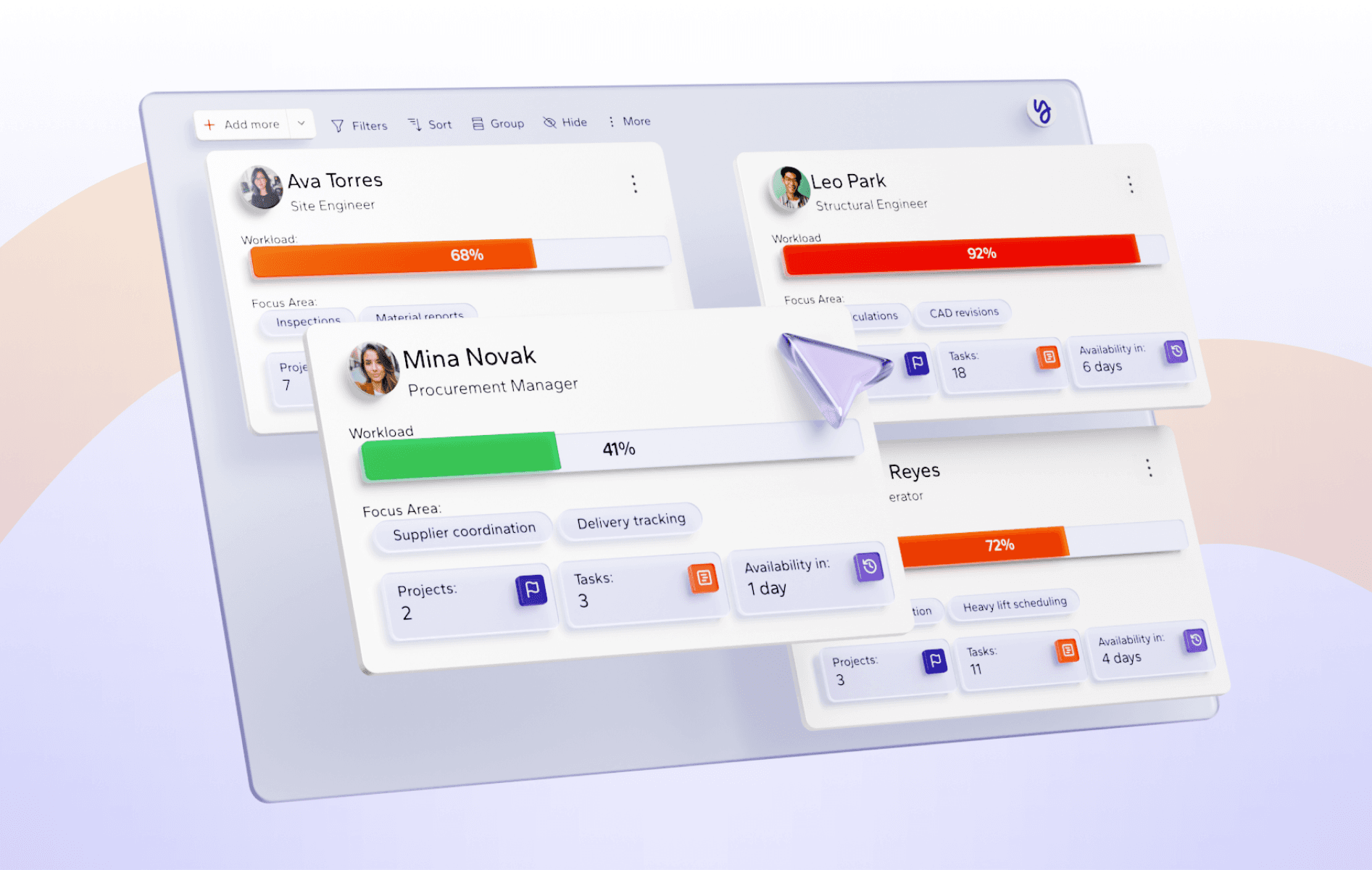
Where Playbook helps is with the combination problem. Because approvals, confirmations, field updates and documents are attached to the activity they affect, the weak signals accumulate in one place instead of eight, and the system can flag which activity is carrying several of them at once and what that exposes downstream. It cannot make the approval arrive or the crew turn up. It shortens the time between the first signal and somebody with authority seeing it.
What are the most common causes of construction delays?
Late information and approvals, procurement and material delays, labour availability, incomplete predecessor work, design changes, access and permit issues, trade stacking, and unrealistic baseline programmes. Late approvals and unconfirmed labour are the most predictable of these, because both leave a clear trail before the planned start date.
Can construction delays be predicted?
Most delays can be anticipated, though not all can be avoided. Weather and unforeseen ground conditions are genuinely unpredictable. Late approvals, unconfirmed crews and slipping deliveries almost always produce warning signals weeks in advance, provided someone is looking at them against the activity that depends on them.
What is trade stacking and why does it matter?
Trade stacking happens when a delay forces multiple trades to work in the same area at the same time. Productivity falls for everyone involved, safety risk increases, and quality issues become more likely. It is how one delayed activity turns into several.
Note to editors:
High-resolution images and interviews with PYBK leadership team members are available upon request.

Project controls is the discipline of measuring whether a project is going to hit its time and cost targets, and providing early enough warning to do something...

There is no single best construction scheduling tool, and any list that names one is answering a different question from the one you are asking. What exists...

OAC stands for Owner, Architect, Contractor. An OAC meeting brings those three parties together on a regular cycle, usually weekly or fortnightly, to review...